
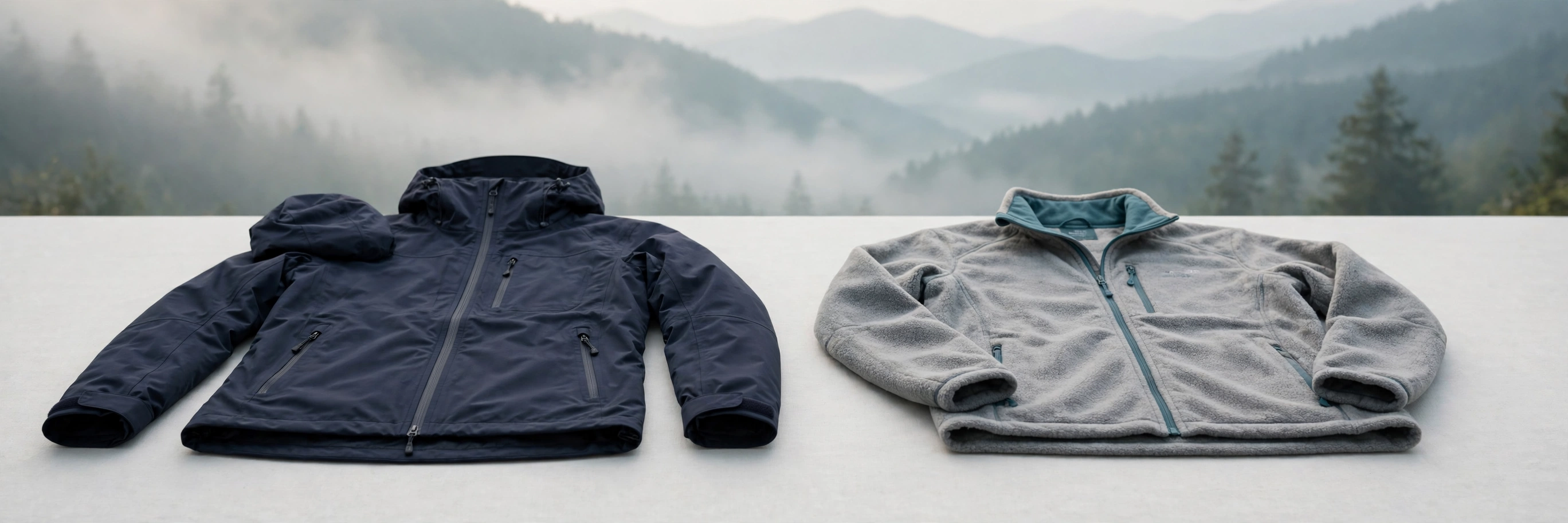
Read waterproof and breathability ratings the way a factory does
Two quotations can both say “10,000 / 10,000” and describe very different jackets, because the test method behind each number is different. Always ask for the value and the method together, and write both into your specification. Final values for your style are confirmed per style on the approved sample and its material test reports — the bands below are planning guidance, not a claim about a specific Wisp style.
Waterproof rating — hydrostatic head. ISO 811 is a fabric water-penetration test under increasing water pressure. AATCC TM127 and JIS L 1092 also include hydrostatic methods. Specify one standard and procedure, and compare samples tested under matching conditions.[9]
| Hydrostatic head (ISO 811) | What it suits |
|---|---|
| 5,000 mm | Light rain and short exposure; entry-level, price-led systems |
| 10,000 mm | General outdoor use in sustained rain; the common OEM mid-point |
| 15,000–20,000 mm and above | Prolonged, heavy rain and higher-pressure points such as shoulders under pack straps |
MVTR is the rate of water vapour transmission, usually reported in g/m²/24h. RET is the resistance to evaporative heat transfer, reported in m²·Pa/W under ISO 11092. A larger MVTR means more transmission under the stated method, while lower RET means less resistance under the stated conditions. ISO published its third edition of ISO 11092 in 2026, so record the edition on the report.[10]
Cup methods control factors such as temperature, humidity, air gap and cup orientation differently. Ask for the exact procedure or variant, the test conditions and the sample construction. Compare MVTR results only when these conditions match. Specify RET separately when that is the result you need.
| RET (ISO 11092), m²·Pa/W | Hohenstein comfort band | What it feels like in use |
|---|---|---|
| 0–6 | Extremely breathable | Comfortable even at a high activity rate |
| 6–13 | Very breathable | Comfortable at a moderate activity rate |
| 13–20 | Breathable | Uncomfortable at a high activity rate |
| 20–30 | Slightly breathable / poor | Moderate comfort only at a low activity rate |
| Over 30 | Not breathable / poor | Uncomfortable, short tolerance time |
For occupational rainwear in the EU, EN ISO 24232:2025 succeeds EN 343:2019. Commission Implementing Decision (EU) 2026/1971 lists the newer standard as harmonised. Ask the test lab and conformity assessor to confirm the applicable standard and regulatory requirements for your product and timeline, together with the material, seam and finished-garment evidence needed.[6][13]
Retail guidance makes the same point from the buyer's side. REI's Expert Advice on how rain gear works states plainly that, unlike the sleeping-bag industry and its temperature ratings, the rainwear industry has not agreed on test standards, and there is no network of independent test labs measuring performance to one scale — so a spec-by-spec comparison between brands cannot be done from published numbers alone. That is the honest position, and it is why this guide gives you bands, methods and questions instead of a league table of brand ratings.[7]
There is no reliable formula between RET and MVTR. If breathability is a selling point for your range, read our MVTR vs RET guide (linked at the end) before you set the target, and for the full brief template see our Waterproof Jacket Specifications for OEM Buyers guide. In your purchase specification, name one primary method for waterproofness and one for breathability, set the target against that method, and require the same methods on the bulk fabric report. That single habit removes most rating disputes between buyers and factories.
See MVTR vs RET for the measurement methods and Waterproof Jacket Specifications for the buyer’s technical brief.
Seam taping: fully taped is a different product from critically taped
A membrane only waterproofs the panels it covers. Every stitch line is a row of needle holes, and an untaped seam leaks long before the fabric does. Two terms cover very different amounts of work, and your brief must say which one you are buying.
| Term | What is taped | Use it when |
|---|---|---|
| Fully taped (fully seam-sealed) | Every seam in the shell | The jacket is sold as waterproof — this is the correct default for a 3-in-1 shell |
| Critically taped | Only the seams in high-exposure zones, typically hood, neck, shoulders and upper body | The jacket is honestly positioned as water-resistant or showerproof, at a lower price — never label it fully waterproof |
Specify tape coverage and tape-to-laminate compatibility together. Ask for a seam map and inspect seam junctions on the sample. If the brief calls for a finished-garment rain test, agree on the test and evaluation conditions with the lab. ISO 24231:2024 describes a method for exposing finished garments to high-energy droplets from above. Its scope differs from an ISO 811 fabric result.[12]
DWR and the European market: specify the finish and evidence
The membrane keeps water out of the jacket; the DWR (durable water repellent) finish on the face fabric stops the outer surface from wetting out, beading water off so the fabric keeps breathing and does not feel cold and heavy. Traditional DWR chemistries used fluorinated (PFAS-based) compounds. European regulation and brand restricted-substance lists have been moving firmly away from them, including the EU restriction on PFHxA and related substances that applies to clothing and footwear from 10 October 2026, and many European brands already require PFC-free finishes across their ranges.
Studies on selected fabrics found that some non-fluorinated DWR finishes could achieve water repellency comparable to the fluorinated finishes tested, with substantially lower oil repellency. Ask the fabric supplier to document the spray rating initially and after an agreed wash procedure. Include oil-repellency testing when the wearer’s job requires it.[3][4]
Commission Regulation (EU) 2024/2462 added entry 79 to REACH Annex XVII. Since 10 October 2026, the entry restricts PFHxA in in-scope consumer clothing, related accessories and footwear at concentrations of 25 ppb or more for the sum of PFHxA and its salts, or 1,000 ppb or more for the sum of PFHxA-related substances, measured in homogeneous material. Confirm the scope and applicable exemptions for the destination and product type. A DWR chemistry label on its own cannot establish the concentrations in each material.[5]
If the product brief calls for a non-fluorinated DWR, identify the claim scope and materials covered. Agree on the documentary and analytical evidence for the destination market alongside the acceptance level for surface wetting under ISO 4920. Record the wash protocol and reassessment point in the specification.[11]
The zip-in interface is where 3-in-1 jackets fail — test it on the proto
Ask any factory that makes 3-in-1 systems where complaints come from and the answer is rarely the membrane. It is the interface: the zip that connects liner to shell. If the liner zip and the shell zip differ in gauge, tooth type, length or slider, the liner will not attach smoothly, will pucker along the front, or will detach at the bottom. If the attachment points at the neck and cuffs are weak, the liner twists inside the shell every time the wearer puts the jacket on. None of this shows up in a fabric report. All of it shows up in reviews.
- Use a matched zip system: specify the same zip family and gauge for the shell front, the liner front and the connecting zip, from one zip supplier and specification, and record it in the tech pack.
- Check length and alignment: on the proto sample, zip the liner in and out at least ten times, hang the combined jacket, and check that hems align, the front lies flat and neither garment pulls the other out of shape.
- Test the anchor points: pull-test the neck and cuff snap loops or tabs, and put the combined jacket on and off repeatedly — anchors that survive a fitting can still fail in daily use if stitching is light.
- Wear it combined and separate: try the shell alone, the liner alone and the combination with the actual base layers your customer wears. Binding, tight armholes and a liner that rides up only appear in wear, not on a table.
- Approve it in writing: note “interface checked and approved” with your other proto comments. If the connecting zip changes supplier or gauge for bulk, re-check a pre-production sample — do not assume equivalence.
| Rule of thumb: Never approve a 3-in-1 programme from a shell sample and a liner sample reviewed separately. Approve the system, zipped together, as your customer will wear it. |
|---|