
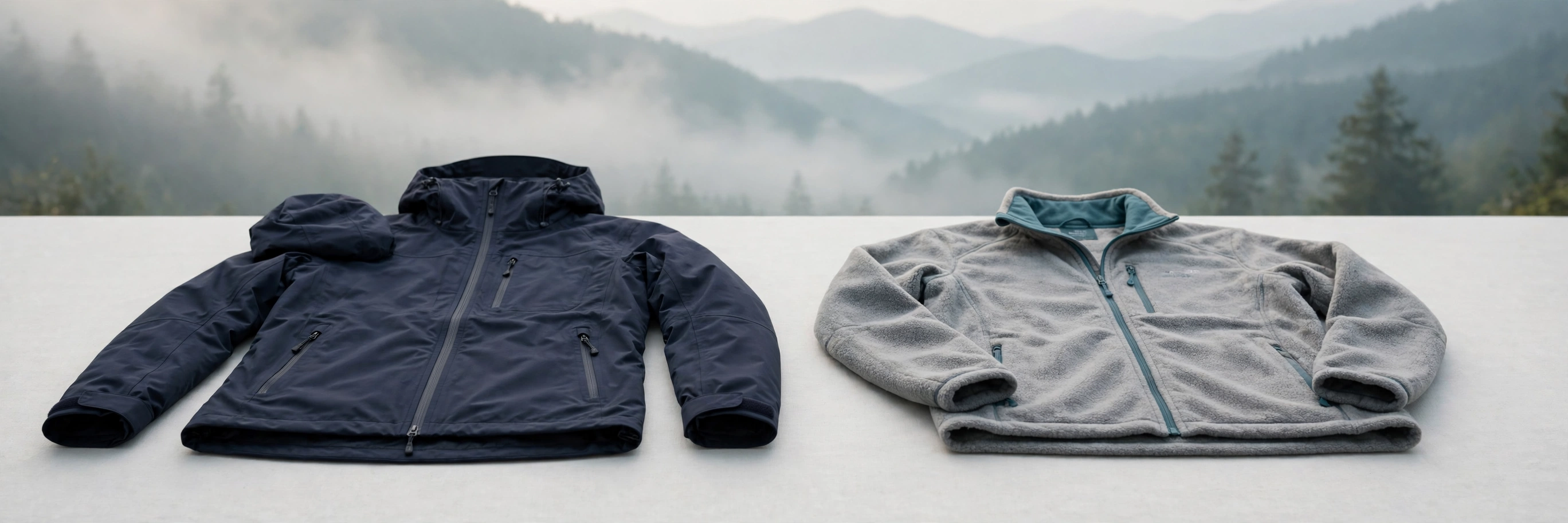
How the named technologies compare — and what to write in your brief instead
Buyers often brief by brand name: “like GORE-TEX”, “PrimaLoft liner”, “Polartec fleece”. Brand names are useful shorthand for a mechanism and a quality tier, but they are not specifications, and two of the commonest shorthand uses are simply wrong. Use the comparisons below to translate a brand reference into the function, figure and method your factory can actually price and reproduce. If you do want the genuine branded material, say so explicitly and budget for its licensed cost and minimums; if you want equivalent function, specify the function and let the factory propose the material that meets it.
| Membrane route | Mechanism | Strengths | Watch out for |
|---|---|---|---|
| ePTFE microporous — the GORE-TEX route | Pores between droplet size and vapour-molecule size (see the Gore figures above) | Benchmark waterproof-breathable performance and durability in 3-layer laminates | Licensed, branded material: cost, approval and supply are controlled by the licensor; the brand name alone does not state which laminate or rating you get |
| PU microporous (generic OEM) | Same pore principle, in polyurethane | Similar function at OEM cost; wide choice of face fabrics and price points | Performance varies widely by supplier — the test method and target in your brief are the only protection |
| PU hydrophilic, non-porous (generic OEM) | No pores; solution-diffusion through a solid film | No pores to clog or contaminate; can be quieter and stretch-friendly; robust in coatings and 2.5-layer builds | Breathability depends on the humidity gradient, so it behaves differently in cold, dry conditions; judge it by a RET figure, not by feel on a hand sample |
| Coating only, no membrane | A waterproof coating on the face fabric, no separate membrane film | Lowest cost; adequate for light-rain, price-led systems | Lowest breathability and durability of the four; do not position it against membrane shells |
| Liner brand shorthand | What the name really means | Write this in the brief instead |
|---|---|---|
| “PrimaLoft liner” | A synthetic-insulation family; Gold is its premium warmth-to-weight tier, sold by weight | Insulation type and weight in g/m² — for example synthetic, 100 g/m² — and, if you require the branded fill, the exact grade and weight (PrimaLoft Gold Eco is published in 40 / 60 / 80 / 100 / 133 / 170 / 200 g/m²) |
| “Polartec fleece liner” | A fleece family whose 100 / 200 / 300 are class names for light, mid and heavy fleece — not g/m² measurements | Fleece class plus the fabric's actual g/m² from its data sheet, its finish (for example anti-pill) and whether it must look finished as a standalone jacket |
| “High-fill-power down liner” | Fill power is loft per gram, published roughly from 450 to 900 across the market | Down/feather ratio, fill power and fill weight together, plus the sourcing standard — for example RDS-certified down, which prohibits live-plucking and force-feeding |
| “C6 DWR shell” | A fluorinated, six-carbon DWR chemistry — historically the oil-repellent option | For the EU consumer market from 10 October 2026, C0 PFC-free DWR instead, with the PFHxA limits in Regulation (EU) 2024/2462 written into the material requirement |
The pattern in both tables is the same: every famous name resolves into a mechanism, a number and a test method. A brief that contains those three things can be quoted by any competent factory and checked on the approved sample. A brief that contains only a brand name can be quoted by anyone — and checked against nothing.
How retail brands build a 3-in-1 jacket
The examples below cover fleece, synthetic and down liners across retail outdoor and ski jackets. Each model links to the brand’s specification. Use them to decide which details your brief needs to capture.
Swipe to compare the full table.
| Brand | Model and source | Shell | Liner | Construction detail |
|---|---|---|---|---|
| Columbia | Bugaboo IV 3-in-1 | Omni-Tech | Zip-in polyester fleece | Critically seam sealed; 3-point Interchange |
| REI Co-op | Powderbound 3-in-1 | Waterproof breathable shell | MidLoft polyester: 80 g body, 60 g sleeves | Removable insulated liner |
| Helly Hansen | Swift 3-in-1 Ski Jacket | HELLY TECH Performance | PrimaLoft Black Eco, 100 g | Fully seam sealed; CIS 3in1 System |
| Patagonia | Women’s Tres 3-in-1 Parka | H2No Performance Standard 2-layer shell | Zip-out 700-fill-power recycled down | Parka-length shell |
| Mammut | Treeline 3 in 1 HS Hooded Jacket | 2-layer GORE-TEX with ePE membrane | 700 fill-power down | Separately wearable shell and liner |
Named shell systems can help place a product in the range. For your own jacket, specify the laminate and include the test methods required for the performance claims you intend to make.
Liner choices help position the range. The benchmark shows fleece in examples such as Columbia’s Bugaboo IV, synthetic insulation in ski models such as Helly Hansen’s Swift and down in models such as Patagonia’s Tres. Compare the full insulation specification and garment fit when setting the warmth target.
Taping is a separate construction choice. Columbia specifies critical taping on the Bugaboo IV, while Helly Hansen specifies full seam sealing on the Swift. Ask for a seam map when comparing quotes and check the agreed coverage on the sample.
Brand names for attachment systems describe their own product designs. If you need interchangeable liners across several styles, specify the connection geometry and verify compatibility in each intended size during sampling.
Retail prices can vary by country, color and promotion. To compare manufacturing costs, send each supplier the same specification revision and order splits. Ask for the test procedures behind any published performance figures you plan to use as targets.
What changes the price of a custom 3-in-1 jacket
Buyers often ask for a single “3-in-1 jacket price”. There is no meaningful single price — there is a specification with a price attached. These are the levers that move it most, in roughly this order:
- Shell fabric and membrane: 3L shells cost more than 2.5L; higher waterproof and breathability targets need more expensive membranes and face fabrics.
- Liner insulation: 90% down costs more than 50% down, which costs more than most synthetic fills, which cost more than fleece. Fill weight matters as much as fill type.
- Zip system: A matched, branded zip system, water-resistant front zips and quality sliders cost more than generic zips — and are usually worth it at the interface.
- Seam taping and construction: Full seam taping, laser-cut or bonded details, and complex pocketing add machine time and labour.
- Branding on two garments: Two garments means two sets of labels, logos and packaging decisions. Heat transfers, embroidery and custom zip pullers each add a small cost that multiplies across shell and liner.
- Quantity and colour split: At 300 pieces, fabric minimums and colour splits matter. Fewer colours and a shared shell fabric across styles will price better than many small colour splits.
The fastest way to a useful quotation is to send the specification, not just a photo. A reference photo plus the checklist below will get you a price you can actually plan around; a photo alone gets you a placeholder.